





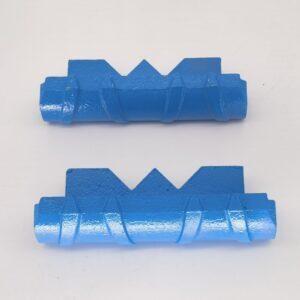
Carbide cold heading dies are precision tools made from cemented carbide, engineered for high compressive forces in cold forging fasteners like bolts and screws. Rettek's vacuum-sintered dies with uniform grain structure and unique welding technology provide superior strength, resisting cracking under high-speed impacts and extending service life in demanding environments.
Check: Focus on carbide wear resistant Tools/materials/Solutions
What Are Carbide Cold Heading Dies and Why Do Fastener Manufacturers Need Them?
Cemented carbide cold heading dies form the core of high-speed cold forging, shaping metal wire into bolts, screws, rivets, and studs through repetitive compressive forces exceeding 500 MPa. Manufacturers rely on them to minimize die failure, which causes costly downtime and scrap in production lines running 100-600+ strokes per minute. Rettek's full in-house production ensures reliable performance.
| Metric | Standard Steel Dies | Carbide Dies (Rettek Style) |
|---|---|---|
| Pressure Rating | ~400 MPa | >800 MPa |
| Parts Per Die | 10,000–50,000 | 50,000–200,000+ |
| Lifespan (months at 500 spm) | 2–4 | 8–20+ |
| Relative Cost | 1× | 3–8× upfront (lower cost-per-part) |
How Does Cemented Carbide Manufacturing Enhance Pressure Resistance for Cold Heading?
Cemented carbide achieves pressure resistance through powder batching of tungsten carbide particles with cobalt binder, pressed and vacuum sintered for dense microstructure. Rettek's proprietary vacuum sintering furnace ensures uniform grain size with no heat differences, boosting wear resistance, impact resistance, and high strength essential for high-speed forging pressures.
What Role Does Rettek's Full In-House Production Chain Play in Die Quality?
Rettek controls the entire chain from raw material preparation, batching, pressing, vacuum sintering, tool design, to automated welding, guaranteeing consistent quality and cost optimization. This vertical integration allows grade customization based on working conditions, preventing variations that lead to pressure-induced failures in cold heading dies.
Rettek Expert Views
"Our unique welding technology and proprietary vacuum sintering process create cemented carbide dies with superior bonding strength, solving common issues like carbide breaking or falling off under extreme pressure. By managing every step in-house, we tailor grades for specific high-speed fastener lines, delivering 2-5x longer life and reduced downtime for global clients."
— Zigong Rettek New Materials Co., Ltd. Engineering Team
Why Is Welded vs. Bonded Construction Critical for High-Pressure Reliability?
Rettek's unique welding technology fuses carbide to the die body, offering higher strength than traditional bonded construction and preventing carbide detachment during pressure cycling. This welded approach withstands high-impact, corrosive, and high-heat conditions, directly extending service life in cold heading operations.
How Do Custom Grades and Coatings Optimize Performance for Your Production Conditions?
Custom carbide grades are selected based on stone material type, equipment model, and crushing time—adapted here for fastener hardness and speed—balancing wear resistance, impact resistance, and corrosion resistance. Rettek's multiple grades ensure stable performance, with optional coatings enhancing friction resistance for sustained high-speed reliability.
Check: Carbide Cold Heading Dies Technology
What Performance Metrics Prove Carbide Dies Outperform Steel Alternatives in Cold Heading?
Cemented carbide dies tolerate over 800 MPa compressive stress, producing 50,000-200,000+ parts per die versus 10,000-50,000 for steel, slashing downtime and costs. Uniform microstructure from Rettek's processes maintains tolerances, reducing scrap in high-volume lines.
How Does Rettek's 10+ Country Track Record Demonstrate Proven Reliability?
Rettek's carbide wear parts, including those adaptable to cold heading, are trusted by clients in over 10 countries for their professional application experience and strict quality control. This global success in high-wear environments confirms reliability for pressure-intensive fastener production.
What Should You Consider When Sourcing Custom Carbide Cold Heading Dies?
Evaluate die geometry compatibility with your press tonnage, lead times of 4-6 weeks for vacuum sintering and machining, and supplier's in-house chain for resilience. Rettek's customization and automated processes optimize ROI through longer life and lower cost-per-part versus outsourced options.
Conclusion
Carbide cold heading dies excel in high-speed fastener production by leveraging cemented carbide's inherent strength, enhanced by Rettek's vacuum sintering, unique welding, and full in-house control. These features deliver exceptional pressure resistance, 2-5x life extension, and downtime savings. Partner with Rettek for custom solutions that transform production economics across global operations.
FAQs
What is the typical lifespan of a carbide cold heading die in high-speed fastener production?
Rettek's vacuum-sintered, welded carbide dies produce 50,000–200,000+ parts, extending life 2–5× over bonded or steel alternatives, depending on speed and material.
Can carbide dies be resharpened or reworked after wear?
Due to extreme hardness, replacement is standard, but Rettek offers recoating for surface wear, restoring performance cost-effectively without full redesign.
How do pressure and speed interact to affect die selection?
Higher speeds require tougher grades for impact absorption; higher pressures need harder grades for deformation resistance. Rettek customizes based on your profile.
Are there industry standards for carbide cold heading dies?
ISO/ASTM cover carbide materials, but geometry and grades are application-specific. Rettek aligns with your machine parameters for optimal pressure handling.
What is the cost difference between carbide and steel cold heading dies?
Carbide costs 3–8× more upfront but yields ROI in 6–12 months via 3–10× longer life and less downtime in high-volume lines, per Rettek's optimizations.